METHOD / HOW THIS REBUILD IS MADE
Built like a book, moved like a camera
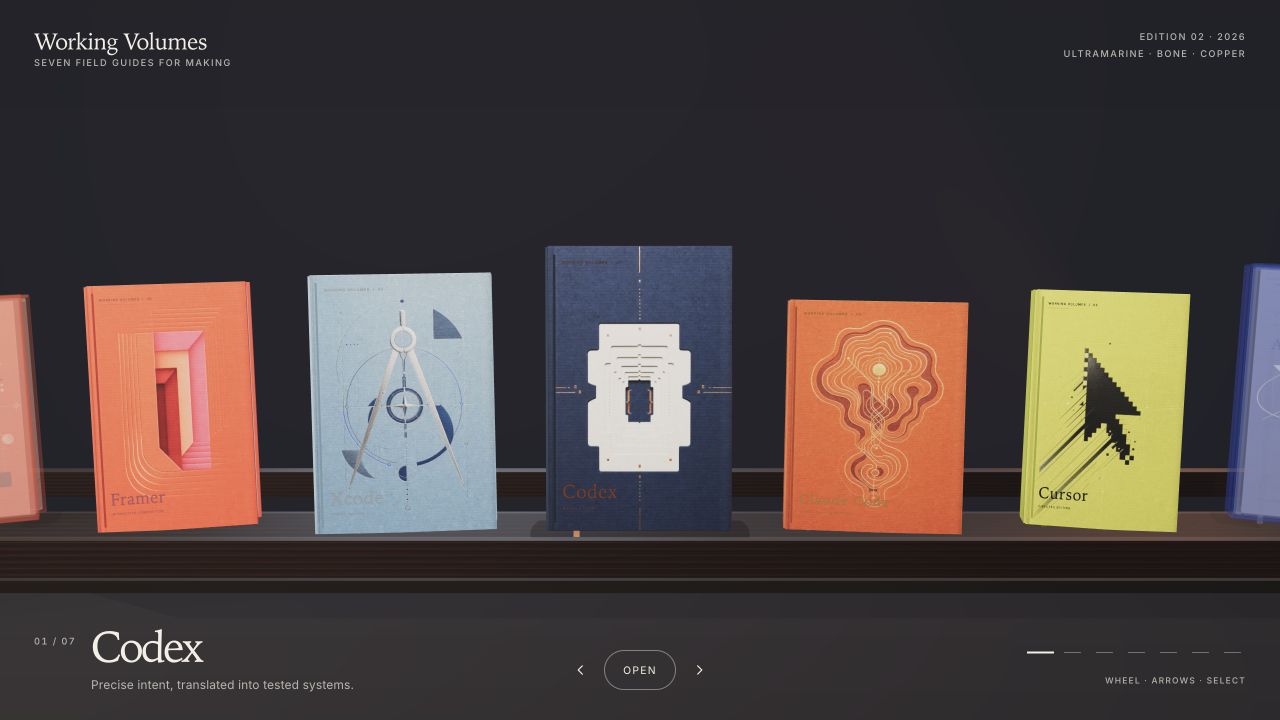
Every volume is assembled from separate parts — boards, spine shell, hinges, endpapers, a striped page block, headbands and a ribbon — and every surface is painted at runtime onto canvases. Nothing is downloaded except the font.
iHardcover construction
Each book is a rig of meshes: hinged front and back boards with turn-in strips, a rounded cloth spine carrying an embossed foil stamp, patterned endpapers, headbands top and bottom, six signature slivers on the fore-edge and a ribbon bookmark. A radial-gradient plane grounds each volume with a contact shadow.
iiA continuous shelf
The seven volumes live in one wrapped coordinate; the shelf never ends. Wheel, arrows, buttons and markers move a damped target position, books lift and brighten as they approach focus, and distant copies fade out before wrapping around to re-enter from the other side.
iiiCurved leaves
Open a volume and its leaves are segmented planes deformed per-vertex: an arch of sin(πt) plus a squared free-edge lift gives the bend, drag velocity feeds a tiny spring that adds curl and twist, and past the commit threshold the leaf lands on the pile on the other side.
WHEEL glide along the shelf
← → previous / next volume
MARKERS jump to any volume
CLICK BOOK pull it into inspection
HOVER cracks the cover open
CLICK AGAIN opens fully
DRAG PAGES turns with real bend
DRAG BG orbit · right-drag pan · wheel zoom
ESC return the volume to the shelf
An independent tribute rebuild for The MengTo Atlas, after Meng To's
complete-shelf. His embedded WebP cover atlases are replaced here by procedural canvas cloth, foil,
paper-edge striping and wood grain; the construction, choreography and page physics follow his implementation.
Product names are used editorially and remain the property of their respective owners.